01
How to Read a Geospatial Opportunity Score
A practical guide to interpreting demand, competition, accessibility, and confidence before choosing a site.
opportunity scoringsite selectionH3 grids
Practical writing on opportunity scoring, travel-time analysis, population grids, competition pressure, and the caveats that make map-based decisions defensible.
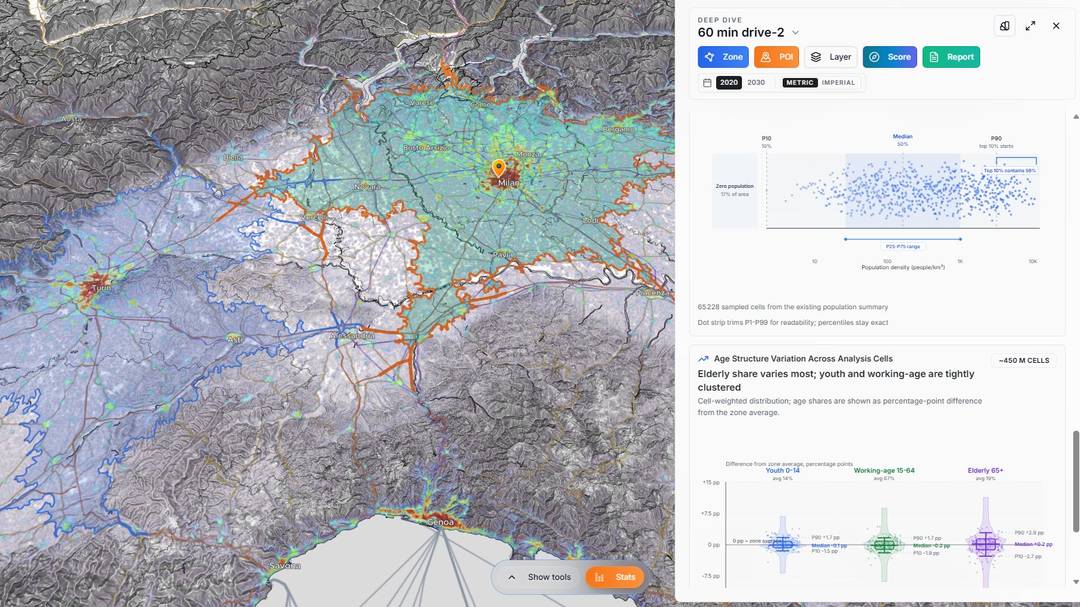
Population, demographics and catchment assumptions stay visible beside the map.
Short, applied pieces for teams comparing catchments, explaining rankings, and deciding where to look next.
A practical guide to interpreting demand, competition, accessibility, and confidence before choosing a site.
Compare travel-time isochrones and distance-radius maps, including when each catchment is useful and where each can mislead.
Understand what shapes a drive-time map, why it is not a live-traffic forecast, and how to validate a catchment before using it in a decision.
See how Horizon Mapper combines a selected polygon with population and demographic rasters, and why resolution and precision still matter.
Start from the field decision, then choose the geography and scoring inputs.
Read demand, supply, access friction, and confidence together before acting.